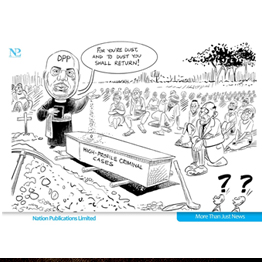

There is a cartoon doing the rounds that deserves more than laughter.
It shows a political figure standing over a coffin labelled “High-Profile Criminal Cases.” He sprinkles dust and declares, “For you are dust, and to dust you shall return.” The public kneels. Two small figures stand aside, confused.
It is satire.
But it is also diagnosis.
The cartoon is not about one party. It is not about one administration. It is about something deeper. Something structural. It captures the moment when political power appears to close legal matters not through transparent judicial process, but through performative authority.
And that is where democracy begins to fracture.
Democracy is not self-authenticating. Elections do not sanctify everything that follows. Institutions do not automatically restrain power simply because they exist in a constitutional text. The presence of courts, anti-corruption bodies, or prosecutorial offices does not guarantee that law governs politics. Sometimes politics governs law.
When high-profile criminal cases appear to be buried through political posture rather than visible legal reasoning, the public does not merely lose confidence in a case. It loses confidence in the system. And that is a far more dangerous loss.
This is what I call a politicojuridical rupture.
A rupture occurs when political authority begins to derive its force from something other than law: popularity, party dominance, moral theatre, religious metaphor, public fatigue, or sheer executive momentum. The outward form of legality may remain. The statutes are still printed. The courts are still open. The institutions still function.
But something shifts beneath the surface.
Law becomes procedural decoration rather than authoritative restraint.
The cartoon captures this moment with unsettling clarity. The burial is not the problem. Cases collapse all over the world when evidence fails. Prosecutions are withdrawn. Acquittals happen. That is normal. That is law.
What is abnormal is when closure feels political rather than juridical.
When citizens cannot tell whether a case died because the evidence was weak or because power was strong, democracy begins to wobble. When political actors speak with the tone of final judgment over matters that belong to legal institutions, we are no longer watching rule of law. We are watching authority performing sovereignty.
And sovereignty without restraint is always dangerous. Even when elected.
This is why democracy alone is insufficient. Elections choose leaders. They do not legitimise the burial of law. Institutions exist on paper. But unless they are insulated from political dominance, they become instruments rather than referees.
Politicojuridity insists on one simple but demanding principle: Political power must visibly derive its authority from law; and remain demonstrably constrained by it.
If the source of authority shifts; to charisma, to party, to numbers in Parliament, to popular applause; then law becomes subordinate. And when law becomes subordinate, legitimacy begins to decay.
To ensure that political power is truly subject to law, Politicojuridity proposes redesigning the state so that all sources of legitimacy are consciously drafted into its architecture. Only when cultural authority, moral authority, constitutional authority, and popular authority are structurally harmonised within the state’s design can the republic truly belong to the people it is meant to serve; and not merely to the political players who temporarily occupy it.
The two small figures with question marks in that cartoon represent the republic. They are asking a silent question:
Was this justice? Or was this power?
When a society cannot answer that clearly, it has crossed from democratic confidence into democratic uncertainty.
That uncertainty is the birthplace of cynicism. Cynicism is the seedbed of instability. And instability is the slow death of constitutional order.
Democracy is not protected by ballots alone. It is protected by the continuous subordination of political power to law.
Without that foundation; without politicojuridical integrity; even the most beautifully drafted constitution becomes theatre. And when law becomes theatre, power always writes the script.